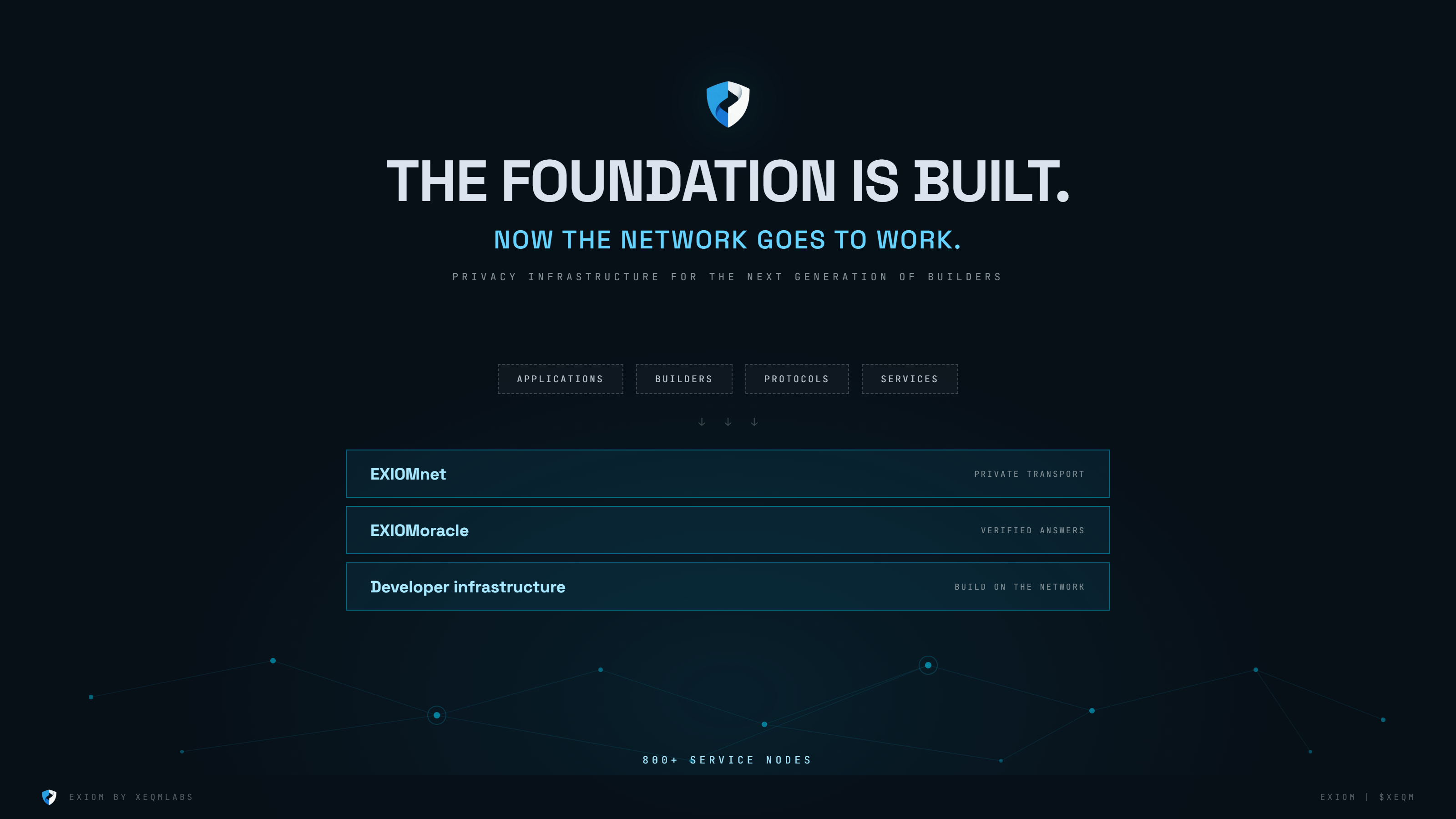
EXIOM Platform Whitepaper
Privacy infrastructure for the next generation of builders. The full EXIOM platform whitepaper: EXIOMoracle, EXIOMnet, service-node economics, XEQM utility, and the investment thesis. August 2026.
Contents
- Executive Summary
- 1. The Builders' Market
- 2. Why EXIOM
- 3. What Exists Today
- 4. From Service Nodes to a Service Network
- 5. EXIOMoracle
- 6. Competitive Positioning
- 7. EXIOMnet
- 8. Business Model
- 9. XEQM: Network Utility and Participation
- 10. Supply and Emissions
- 11. Decentralization and Network Resilience
- 12. Go-to-Market Strategy
- 13. Roadmap
- 14. The Investment Thesis
- 15. Current Status
- Appendix A: Core Network Parameters
- Appendix B: Regulatory Context
- Disclaimer
Executive Summary
XEQMLabs is building privacy infrastructure for the next generation of digital businesses and decentralized applications. EXIOM is a live Proof-of-Stake Layer 1 supported by more than 800 service nodes. With the network foundation established, XEQMLabs is focused on transforming that distributed infrastructure into a commercial platform developers and businesses can consume.
Our thesis is simple: EXIOM grows as builders choose its infrastructure. Every application that integrates EXIOMoracle, EXIOMnet, or other EXIOM services expands network usage and strengthens the commercial value of the platform.
The platform is being developed around three complementary capabilities: EXIOMnet for private network transport, developer infrastructure that exposes network services to external applications, and EXIOMoracle for decentralized access to external information and verification.
EXIOMoracle represents the immediate commercial focus. It is designed to allow an application to request external information, proofs, or verification and receive a quorum-backed result from EXIOM service nodes while minimizing unnecessary disclosure of the underlying information.
Development is already being driven by the requirements of the first application integration. Rather than beginning with a generalized Oracle built around hypothetical demand, XEQMLabs is building the minimum functionality required to solve a real application requirement, proving the architecture end to end, and expanding from demonstrated usage.
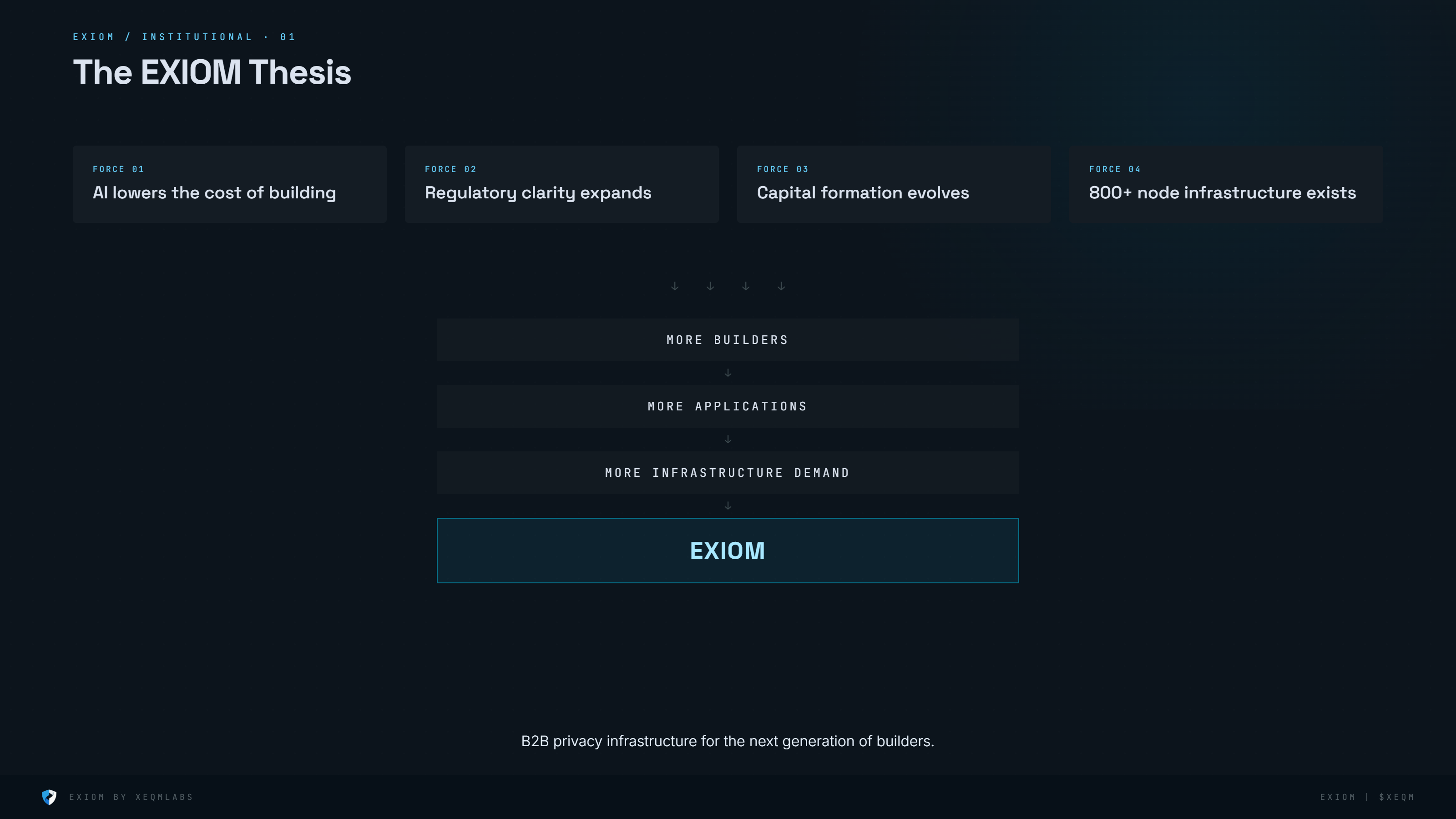
The timing is intentional. Artificial intelligence is reducing the cost and technical barriers associated with building software, while the United States moves toward substantially clearer digital asset regulation and potentially more accessible crypto-native capital formation.
In August 2026, the U.S. Securities and Exchange Commission published proposed Regulation Crypto Assets, a tailored framework that includes potential pathways for qualifying offerings of up to $5 million under a startup exemption and up to $75 million under a broader fundraising exemption. The proposal remains subject to the SEC rulemaking process. Congress is simultaneously advancing comprehensive digital asset market structure legislation through the CLARITY Act.
XEQMLabs believes the convergence of lower development costs, greater regulatory clarity, evolving capital formation pathways, and increasingly capable individual builders can substantially expand the number of businesses launching within the digital asset economy.
Those businesses will require infrastructure. EXIOM is being built for them.
1. The Builders’ Market
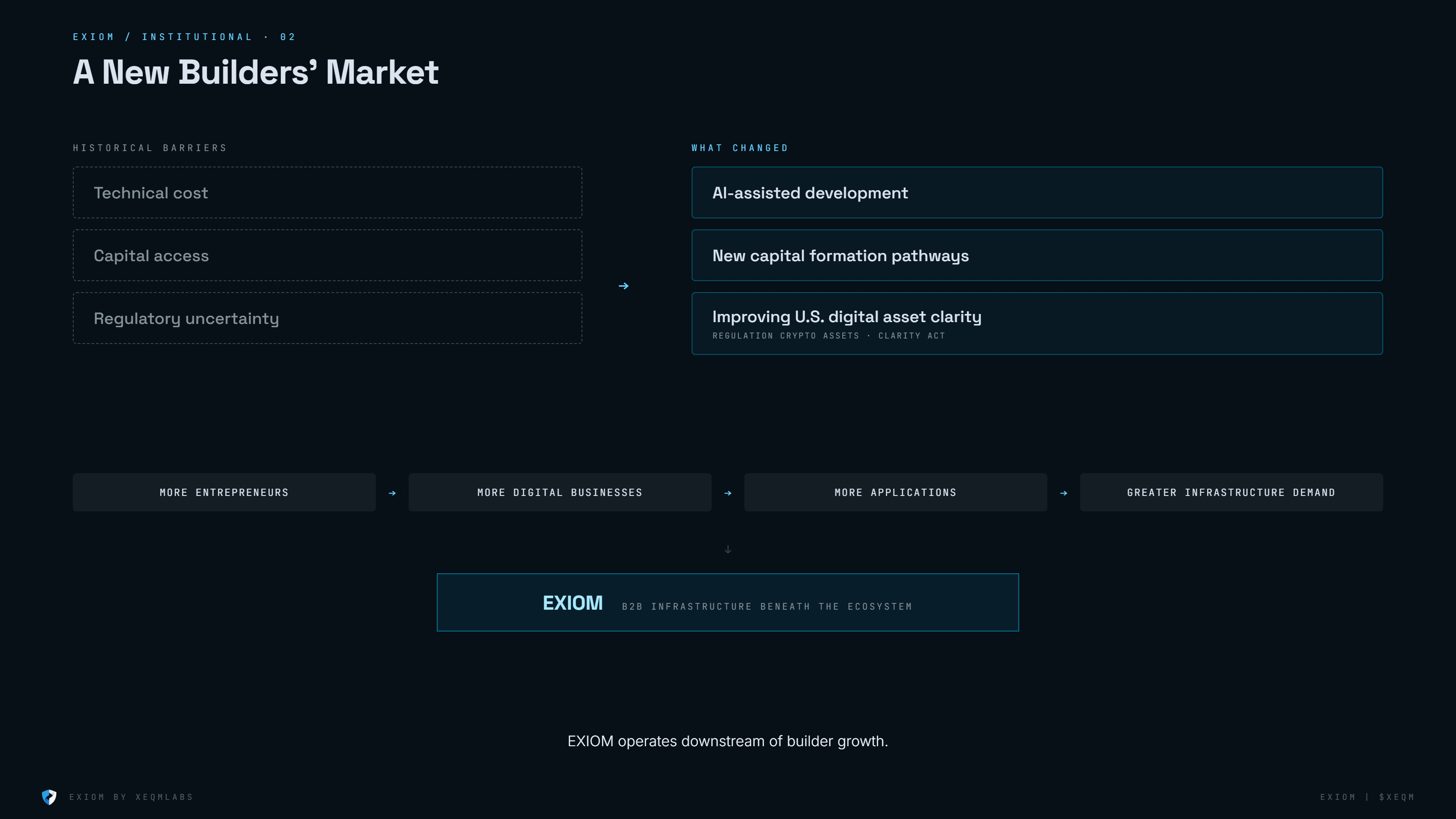
XEQMLabs believes the digital asset industry is approaching an important structural shift. Historically, building a technology company required significant capital, specialized engineering teams, access to investors, and the ability to navigate an uncertain regulatory environment. Each of those barriers is changing.
Artificial intelligence is dramatically reducing the cost of software development. Individuals and small teams can increasingly design, code, test, deploy, and operate products that previously required significantly larger organizations. At the same time, the United States is developing a clearer framework for digital assets and crypto-native capital formation.
Regulation Crypto Assets
On August 21, 2026, the SEC published its proposed Regulation Crypto Assets framework. The proposal is intended to facilitate capital formation and accommodate innovation within crypto asset markets while maintaining investor protections.
Among its most significant provisions are two proposed exemptions from traditional Securities Act registration requirements. The proposed startup exemption would permit qualifying offerings of up to $5 million during a four-year period. The proposed fundraising exemption would permit qualifying offerings of up to $75 million during each 12-month period, subject to additional disclosure, financial statement, and ongoing reporting requirements.
The proposal also includes a conditional safe harbor under which a qualifying crypto asset could be deemed not subject to an investment contract for purposes of the federal definition of a security once specified conditions are satisfied. The proposal remains subject to the SEC rulemaking process, including a public comment period.
If adopted in a substantially similar form, Regulation Crypto Assets could materially change the capital formation landscape for crypto-native businesses. The significance extends beyond existing crypto projects: an entrepreneur building a software product, decentralized service, financial application, AI application, marketplace, network, or other digital business could potentially have a substantially clearer pathway for pairing a functioning product with crypto-native capital formation. This creates the possibility of a much larger builder economy.
The CLARITY Act
Regulatory change is also progressing through Congress. The Digital Asset Market Clarity Act seeks to establish a comprehensive U.S. market structure framework for digital assets, including clearer regulatory responsibilities and rules for digital asset businesses operating within the United States.
The legislation has progressed substantially through Congress and represents one of the most significant attempts to establish durable federal digital asset market structure in the United States. Final passage is not assured and the legislation remains subject to negotiation and the congressional process. Its potential impact, however, is significant.
For years, regulatory uncertainty encouraged many digital asset companies to build outside the United States or limited the willingness of established businesses, financial institutions, entrepreneurs, and investors to participate. A durable federal market structure framework could reduce that uncertainty.
For EXIOM, this represents a potential expansion of the total addressable market. The more businesses that can confidently build, finance, and operate blockchain-enabled products in the United States, the larger the potential customer base becomes for the infrastructure supporting those products.
AI, Capital, and the Individual Builder
These regulatory changes are occurring alongside another structural shift: AI is changing who can build. A solo founder or small team can now move from idea to functioning software with dramatically less capital and engineering overhead than was required only a few years ago. If access to capital also becomes easier, the combination becomes powerful.
Historically, a founder might need to assemble a team, raise venture capital, surrender meaningful equity, and spend years developing a product before reaching a broad market. The emerging model can look different. A small team can use AI to accelerate development, establish a working product, build a community, and potentially access regulated digital asset capital formation without following the traditional venture path in precisely the same way.
XEQMLabs does not assume every business will use crypto. We believe many more businesses will have the option, and that option matters. Every additional digital asset business potentially creates demand for wallets, custody, identity, security, compliance, liquidity, data, networking, verification, and Oracle infrastructure.
EXIOM operates downstream of that growth. We do not need to predict which individual applications will win. We need to provide infrastructure to the builders competing to create them. The thesis is straightforward:
EXIOM is being built to capture a share of that demand.
2. Why EXIOM
Every new digital asset business does not need another blockchain. Many need infrastructure.
Applications interacting with real-world businesses, financial systems, users, private information, external APIs, or off-chain events encounter a fundamental limitation: blockchains cannot independently know what occurs outside their own state. Oracle infrastructure exists to address this problem by connecting decentralized applications with external information.
Privacy introduces an additional challenge. An application may need to know whether a condition is true without needing, storing, or exposing every piece of information underlying that determination. This leads to the problem EXIOM is being built to address:
How can an application obtain and verify the information it needs without unnecessarily exposing the information it does not?
EXIOM combines decentralized service-node infrastructure, quorum-based verification, private network transport, and developer services around this problem.
Our target customer is the builder. Developers, protocols, fintech applications, digital asset businesses, financial applications, AI-enabled services, and other organizations requiring privacy-preserving access to external information or distributed verification represent the addressable market. EXIOM is a B2B infrastructure platform built on decentralized infrastructure.
3. What Exists Today
EXIOM is not a pre-launch network. EXIOM mainnet launched on May 6, 2026. The network currently includes:
- A live Proof-of-Stake Layer 1
- More than 800 active service nodes
- Native XEQM staking and service-node economics
- A live GUI wallet
- A live network explorer
- Auditable supply provenance
- LLARP private-routing technology within the codebase
- Developer infrastructure under active development
- EXIOMoracle under active implementation
The distinction between infrastructure and product is important.
The network foundation has been built. The current phase is about making that network economically productive.
4. From Service Nodes to a Service Network
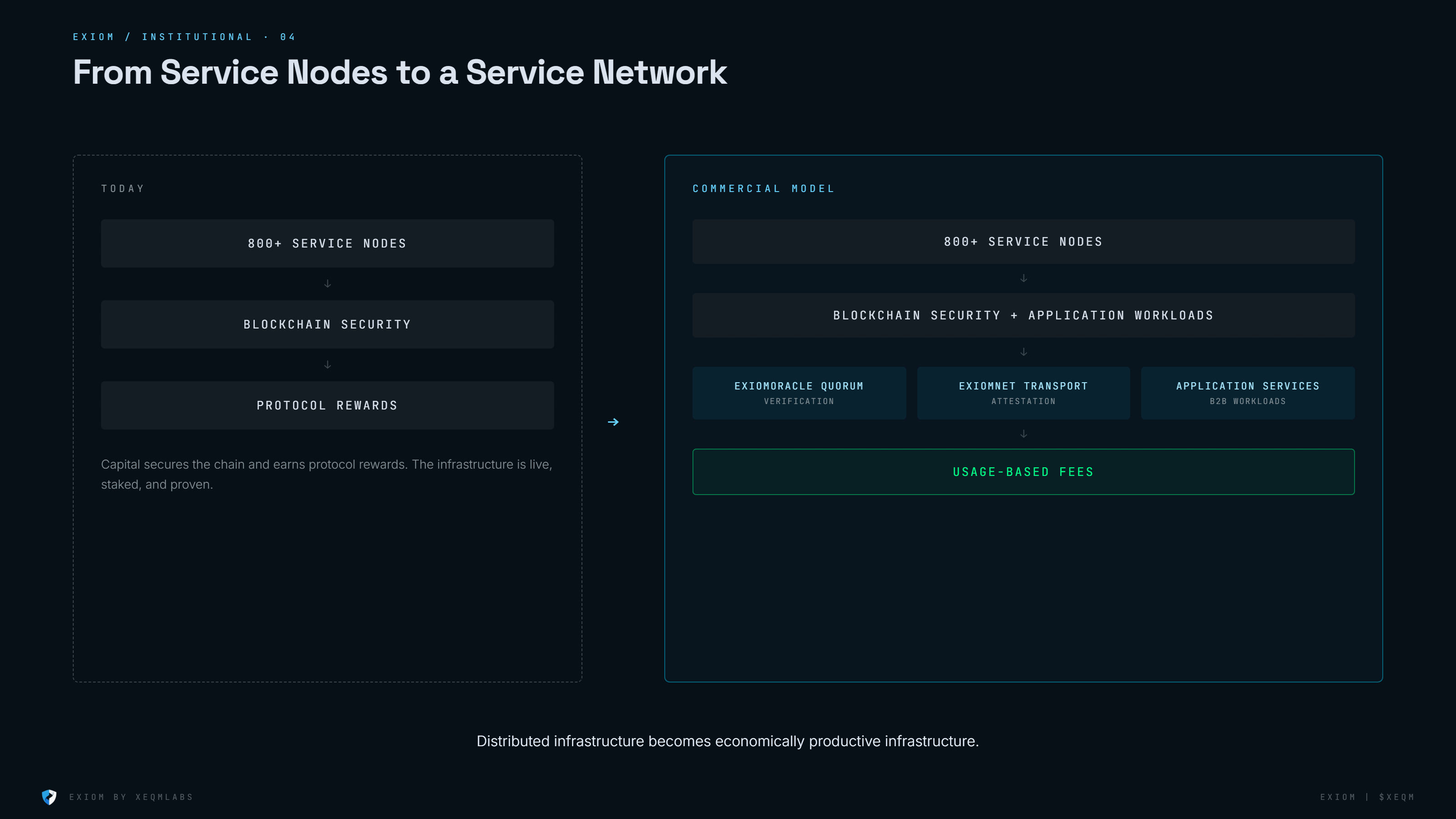
EXIOM’s service-node network is its core infrastructure asset. Today, service nodes primarily secure the blockchain, participate in network consensus, and earn protocol rewards. The commercial opportunity is to extend those nodes beyond blockchain validation into useful application workloads.
Potential workloads include:
- EXIOMoracle quorum participation
- External data verification
- Attestations
- EXIOMnet private transport
- Application requests
- Future developer-defined services
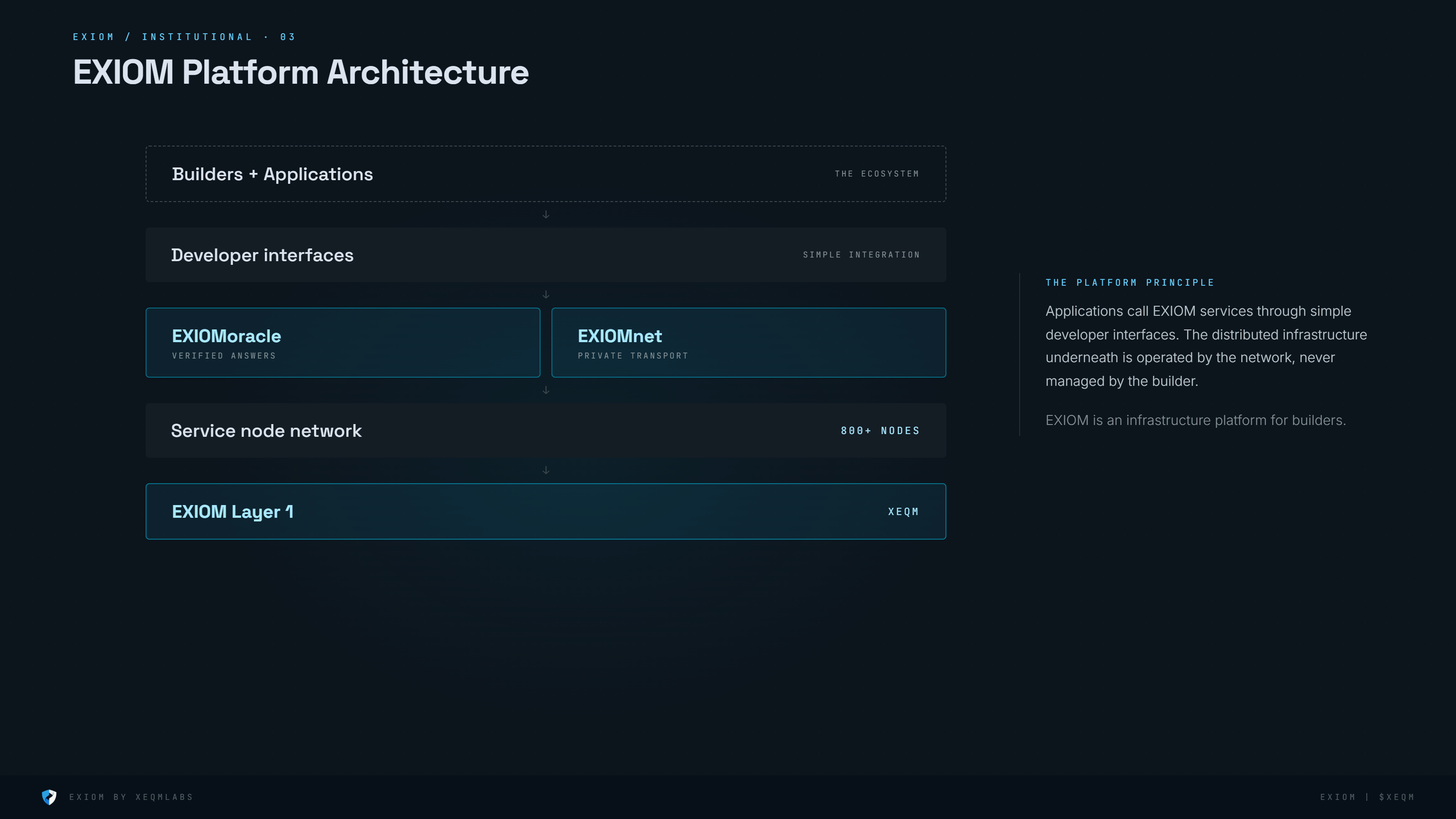
The architecture can be summarized as:
Instead of relying entirely on a centralized server to determine an external result, EXIOM can distribute verification across a rotating quorum selected from the service-node network. This creates an important transition in the economic model: service nodes begin as infrastructure securing EXIOM, and evolve into infrastructure capable of serving customers.
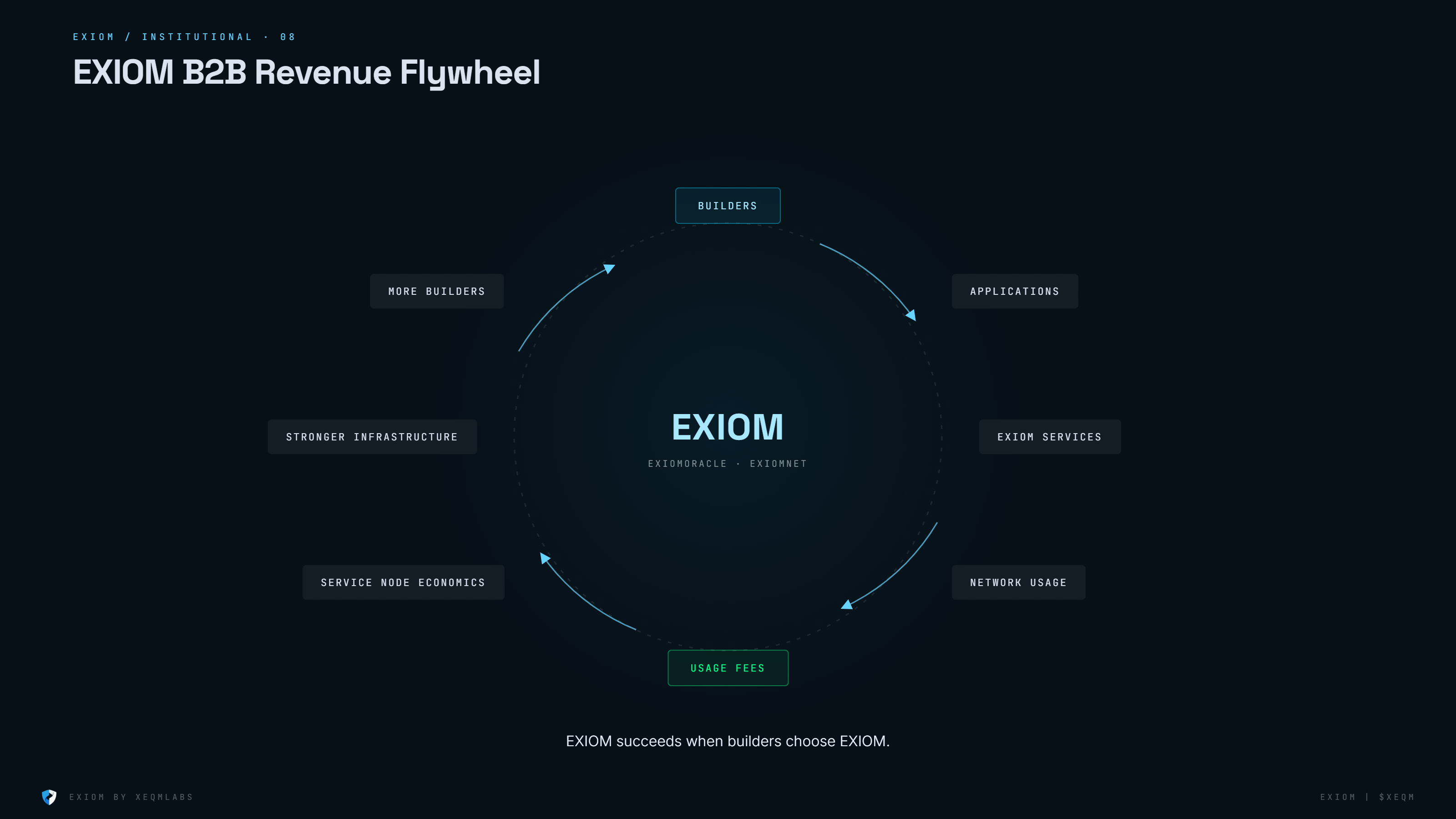
Applications generate requests. Requests generate network activity. Network activity can generate fees. Fees can compensate infrastructure providers and support continued platform development. The long-term objective is an economic model increasingly supported by customers paying the network to perform useful work.
5. EXIOMoracle
EXIOMoracle is the primary product initiative of the current development phase.
Traditional Oracle networks solve an essential blockchain problem: how does a decentralized application know something that occurred outside its blockchain? EXIOM adds another requirement: how can the application obtain a trusted answer without unnecessarily exposing the information behind it?
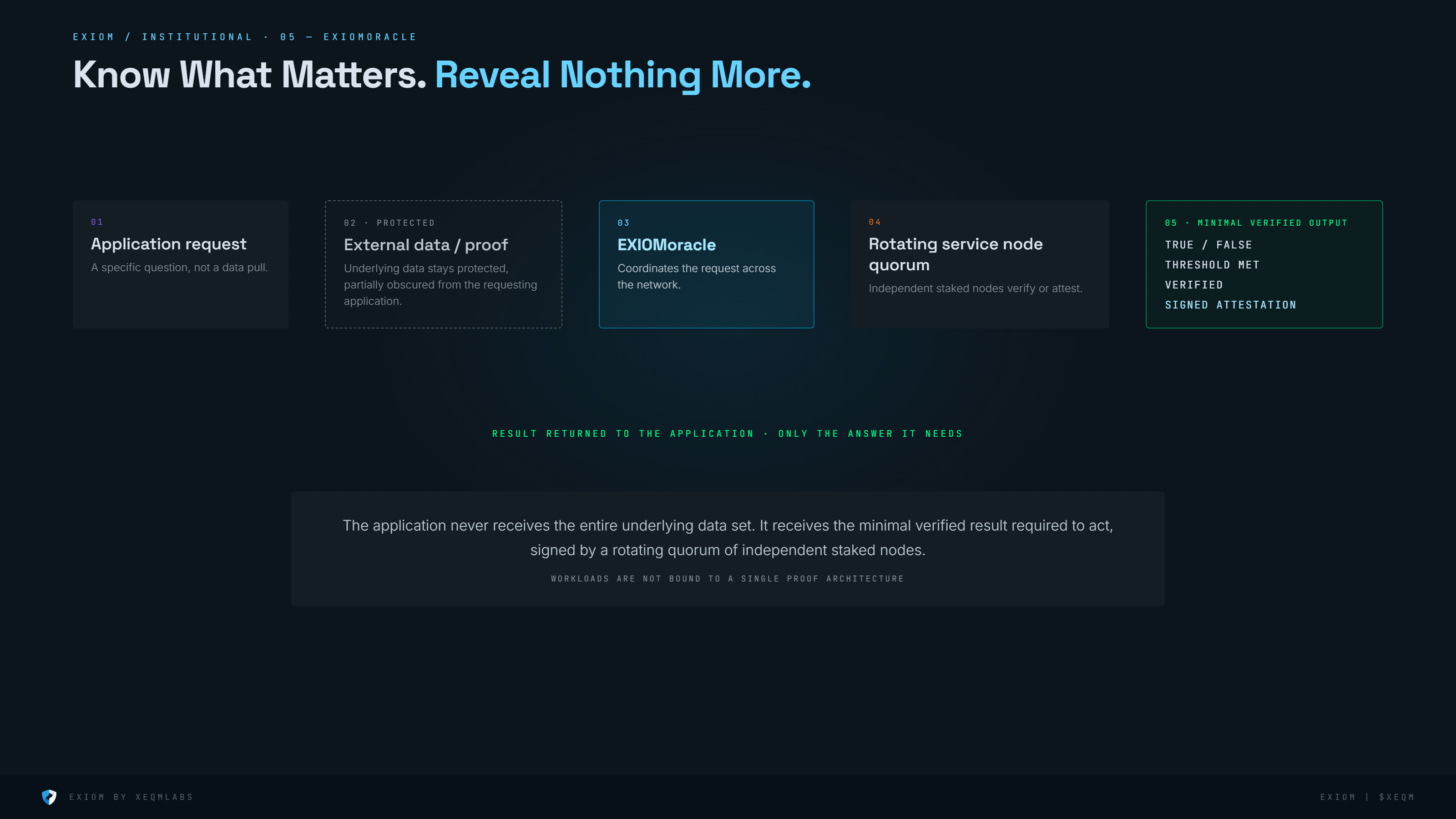
The first EXIOMoracle implementation is intentionally focused. XEQMLabs is currently building against the requirements of a real application that will use external information or proofs, EXIOMoracle logic, and service-node quorum to produce an application-consumable result. At a simplified level:
The resulting output may be a Boolean result, threshold determination, derived value, signed attestation, or other application-specific verification state.
The architecture is designed around minimal disclosure. The consuming application receives the information required to perform its function rather than automatically receiving the complete underlying data set. The first implementation is intended to prove this architecture end to end before EXIOMoracle expands into additional services and use cases. The development philosophy is straightforward:
Build against real demand. Prove the architecture. Generalize from production experience.
6. Competitive Positioning
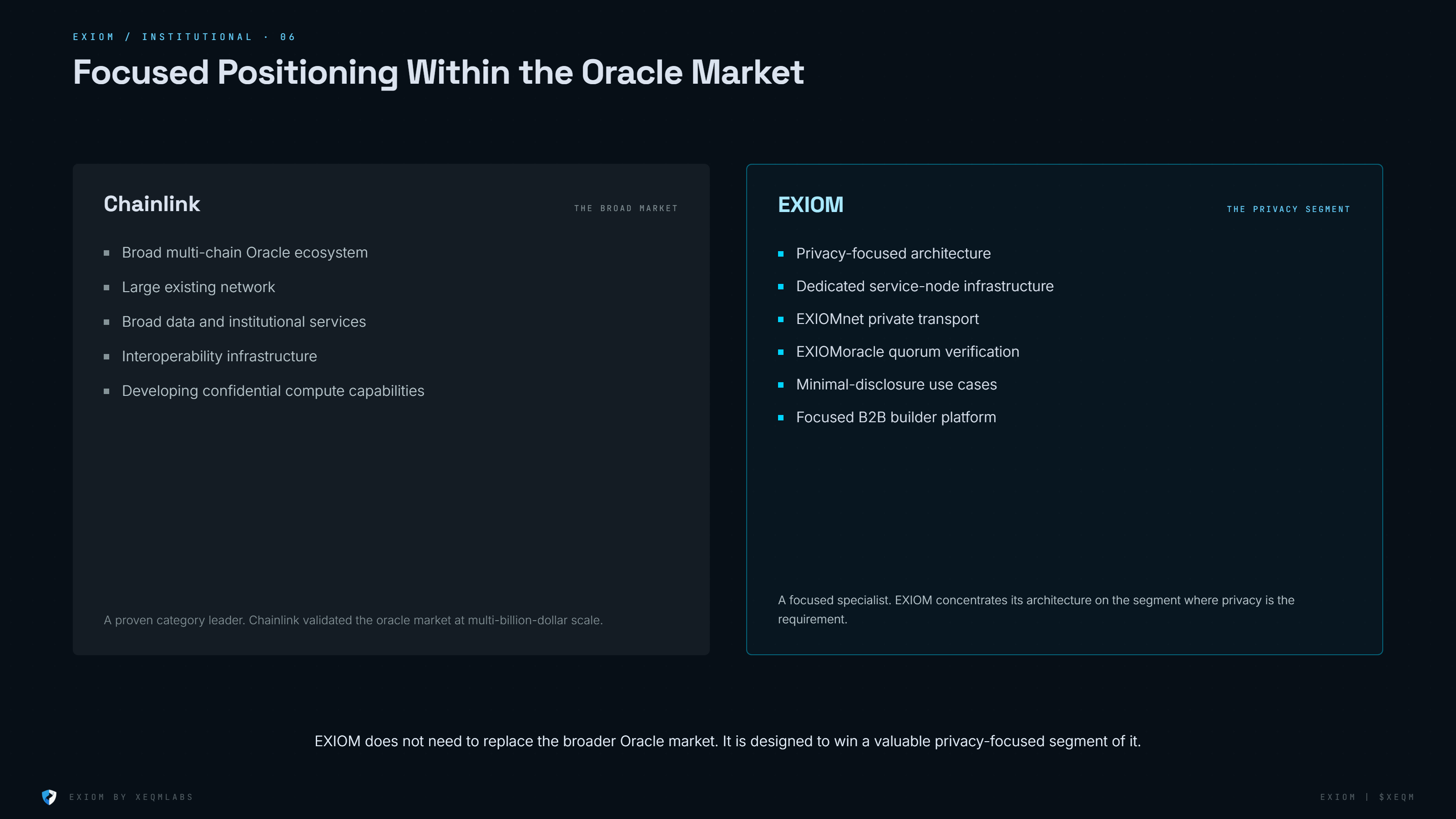
Chainlink demonstrated that decentralized Oracle infrastructure can become a foundational component of the digital asset economy. EXIOM does not need to replace Chainlink to build a meaningful business. It needs to win a valuable segment of an expanding market.
Chainlink has developed a broad Oracle and interoperability ecosystem across numerous chains, applications, data sources, and institutional services. It is also expanding its privacy and confidential-computing capabilities. EXIOM’s strategy is narrower and deliberately privacy-focused.
EXIOM combines a privacy-oriented Layer 1, a dedicated service-node network, private transport through EXIOMnet, quorum-based verification through EXIOMoracle, and a developer platform designed for applications where private or selectively disclosed information matters.
The positioning is differentiated rather than dependent on replacing an incumbent. Chainlink provides broad decentralized Oracle and interoperability infrastructure across a mature multi-chain ecosystem. EXIOM is being built as specialized privacy infrastructure for builders whose applications require decentralized verification, private transport, or minimal disclosure.
A growing builders’ market does not require a single Oracle provider to capture all demand. In a sufficiently large digital asset economy, specialized infrastructure providers can build substantial businesses by serving specific categories of workloads particularly well. EXIOM intends to compete for the privacy-focused segment of that market.
7. EXIOMnet
Privacy does not end with application data. IP addresses, network paths, routing relationships, infrastructure locations, and communication patterns can expose information even when application payloads are encrypted.
EXIOMnet is intended to provide private multi-hop transport for EXIOM services and applications. LLARP, the routing technology underlying Lokinet, is present within the EXIOM codebase and is undergoing engineering assessment and integration as part of EXIOMnet.
Potential applications include:
- Private service-node communication
- Private developer access
- EXIOMoracle transport
- Hidden application services
- Reduced exposure of origin and destination metadata
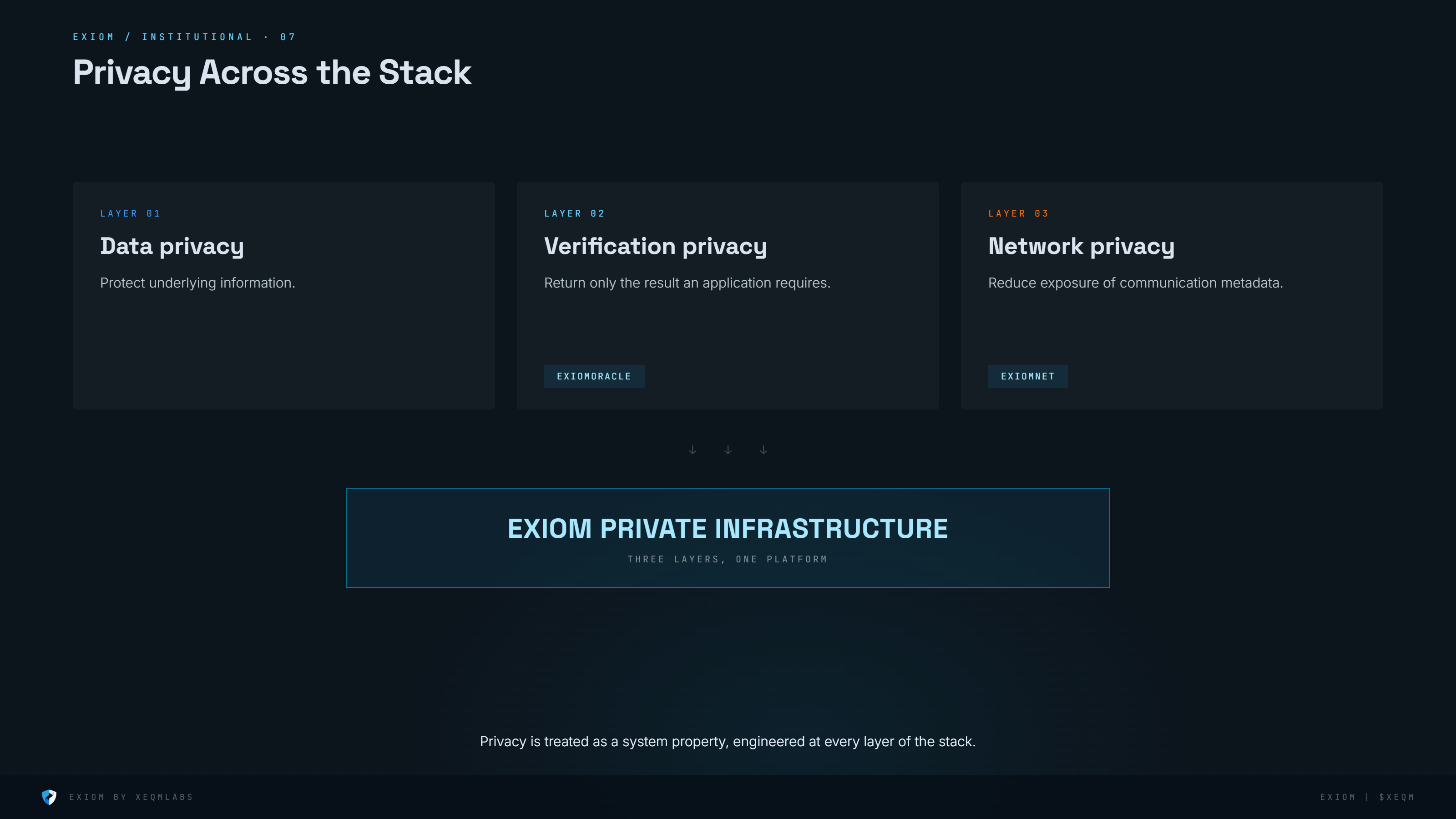
This gives EXIOM the potential to address privacy across multiple layers:
- Data privacy protects the information itself.
- Verification privacy provides applications with the result they require while minimizing unnecessary disclosure.
- Network privacy reduces exposure of communication and routing metadata through EXIOMnet.
The objective is not simply a private transaction. It is private infrastructure.
8. Business Model
EXIOM’s long-term commercial model is based on infrastructure usage:
- Developers integrate EXIOM.
- Applications consume EXIOM services.
- Service nodes provide distributed infrastructure.
- Application usage generates fees.
- Those fees can compensate infrastructure operators and support continued platform development.
Potential revenue-producing services include:
- EXIOMoracle requests
- Verification workloads
- Developer and API usage
- EXIOMnet services
- Application-specific infrastructure
- Future developer-defined services
Today, protocol emissions provide the primary economic incentive for service-node operators. The long-term objective is for customer-generated revenue to become an increasingly important component of network economics. This relationship is central to the investment thesis.
The goal is to grow both sides of the network: more participants holding XEQM, and more businesses consuming EXIOM.
9. XEQM: Network Utility and Participation
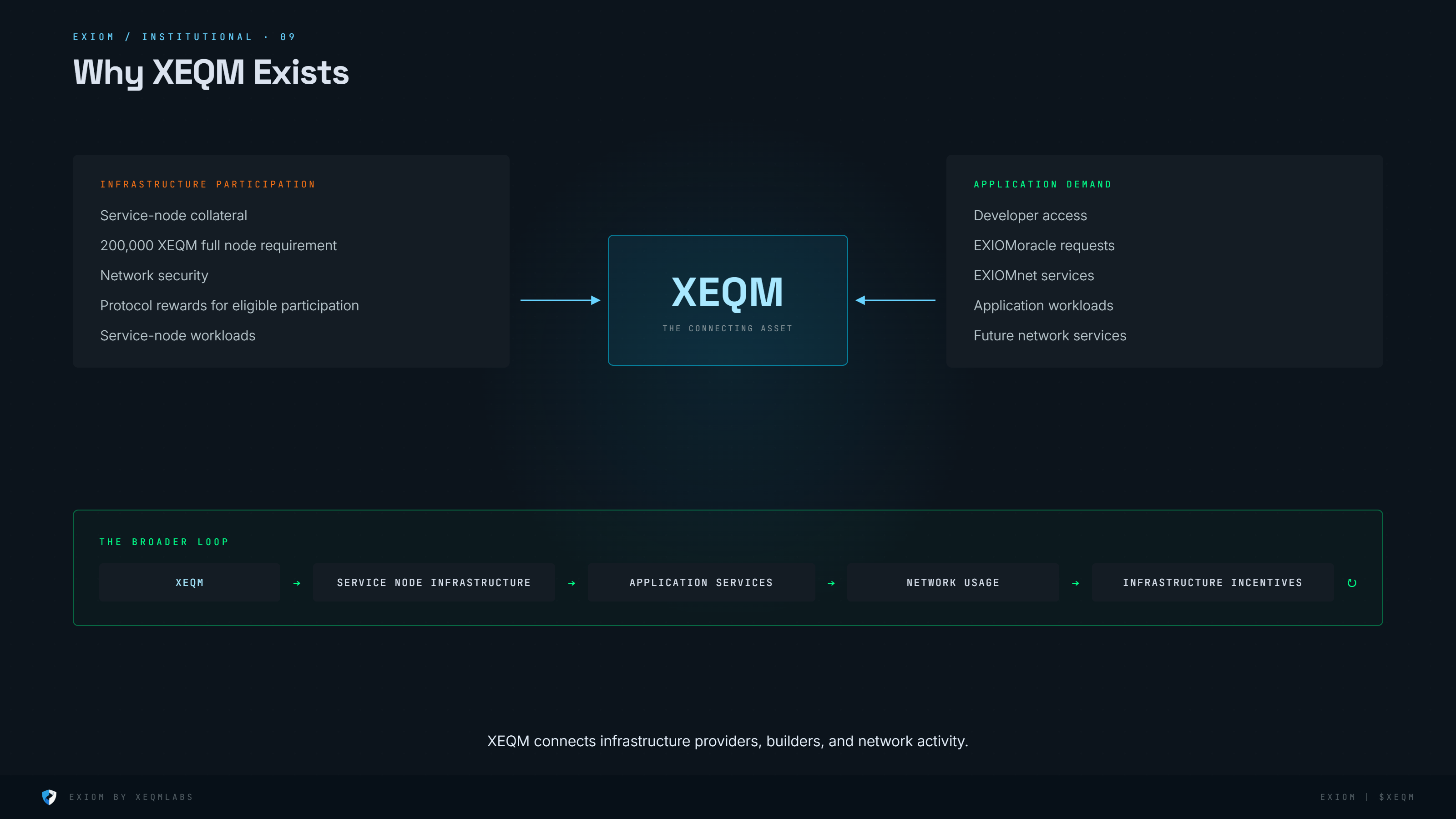
XEQM is the native utility asset of the EXIOM network. Its purpose is to coordinate participation in, access to, and economic activity across EXIOM infrastructure. There are several reasons a network participant may need or choose to acquire and hold XEQM.
Service Node Operation
Operating EXIOM infrastructure requires XEQM collateral. A full service node requires 200,000 XEQM. The operator must contribute at least 100,000 XEQM, while eligible community contributors may provide the remaining collateral according to network requirements. Service nodes perform essential functions for the network and receive protocol rewards for active participation.
As EXIOMoracle, EXIOMnet, and other application services mature, eligible service nodes are intended to perform additional workloads beyond blockchain validation. This creates the potential for network-generated service fees alongside protocol incentives, and provides a functional reason to acquire and hold XEQM: participation in the infrastructure that operates EXIOM.
Service Node Participation
XEQM holders who do not operate an entire service node may participate by contributing collateral to eligible service nodes according to network requirements. This allows multiple participants to contribute toward the collateral supporting network infrastructure without each participant independently operating a complete service node. Rewards are associated with eligible network participation and service-node operation rather than passive ownership of XEQM alone.
Developer and Application Usage
XEQM is also intended to function as an access and usage asset within the broader EXIOM platform. As EXIOM develops commercially, applications may use XEQM to access EXIOMoracle, EXIOMnet, developer infrastructure, and other network services.
This introduces a second source of utility independent of service-node operation: infrastructure providers require XEQM to participate in operating the network, while builders and applications may require XEQM to consume the services that network provides.
Network Economics
These two sources of utility create the intended economic relationship:
As the network develops, XEQMLabs intends for a growing portion of economic activity to originate from applications paying for useful services rather than relying exclusively on protocol emissions. The long-term objective is therefore a network with more XEQM holders and, alongside them, more participants, infrastructure providers, builders, applications, and customers.
Why XEQM Exists
From a network-design perspective, XEQM can provide access to several forms of participation:
- Operating or contributing collateral to EXIOM service nodes
- Receiving applicable protocol rewards through eligible network participation
- Accessing EXIOM infrastructure and developer services
- Paying for EXIOMoracle, EXIOMnet, and future network workloads
- Participating in additional network functions as the platform develops
The utility thesis is tied directly to adoption. If more builders integrate EXIOM, more applications can consume network services. If more applications consume those services, demand for the infrastructure supporting them can increase. XEQM is designed to connect infrastructure providers, builders, applications, and network activity within a common economic system.
Regulatory Position
XEQMLabs describes XEQM according to its intended technical and economic functions within the EXIOM network. References to XEQM as a native utility asset describe its intended use within the network and should not be interpreted as a legal determination regarding its classification under U.S. or other applicable law.
XEQMLabs intends to evaluate XEQM and future platform functionality within applicable regulatory frameworks as those frameworks continue to develop. Nothing in this document represents an expectation, guarantee, or promise regarding the future market value, price, liquidity, regulatory treatment, or investment performance of XEQM.
10. Supply and Emissions
EXIOM launched with a verified starting mainnet supply of 276,917,604 XEQM. Supply provenance is auditable through published records and cryptographic verification. New XEQM enters circulation through defined protocol mechanisms rather than discretionary issuance.
The network produces a block approximately every 60 seconds with a service-node reward of 8.25 XEQM, resulting in approximately 11,880 XEQM of service-node emissions per day. The governance treasury receives approximately 17,857 XEQM per day to support core development, infrastructure, security, ecosystem development, marketing, integration support, and long-term operations. The long-term objective is to reduce dependence on governance emissions as platform-generated revenue develops.
XEQM does not have a hard supply cap. Its monetary model uses predictable ongoing emissions.
11. Decentralization and Network Resilience
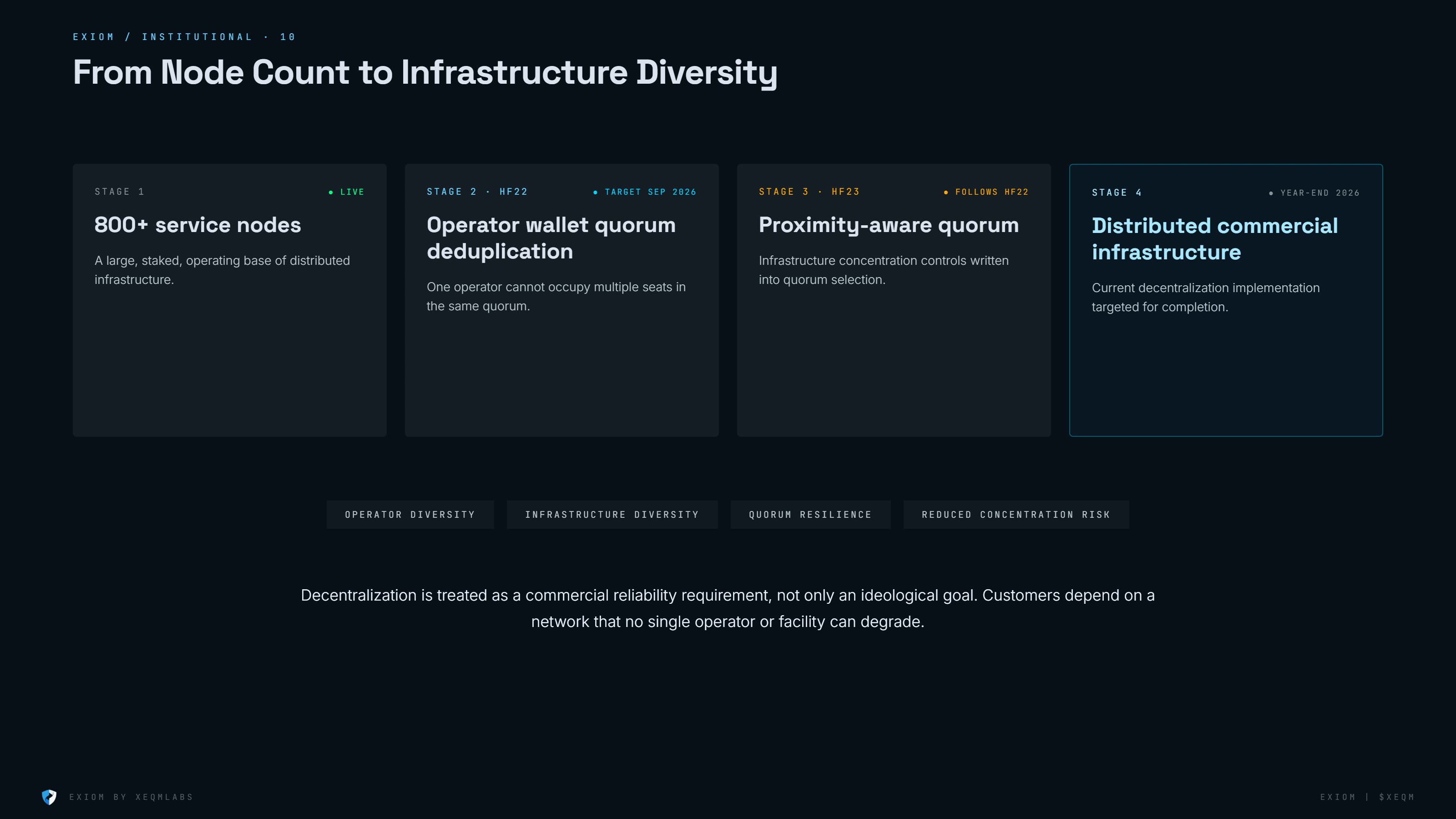
A B2B infrastructure network must remain operational during failures and adversarial conditions. Decentralization therefore has a commercial purpose beyond ideology: a network heavily dependent on a single operator, datacenter, provider, or infrastructure cluster cannot reliably support applications with meaningful availability requirements. EXIOM’s next two planned hard forks focus significantly on this issue.
HF22 — Target: September 2026
HF22 is planned to introduce operator wallet-key quorum deduplication, preventing multiple nodes associated with the same operator wallet from occupying multiple seats within the same quorum round. HF22 also aligns forced deregistration and voluntary unbonding periods.
HF23 — Target: Following HF22
HF23 is intended to extend network resilience through proximity-aware quorum formation and infrastructure concentration controls alongside the required EXIOMnet capabilities. Planned mechanisms include:
- Proximity-cluster identification
- Cluster-aware quorum selection
- Registration concentration limits
- Concentration monitoring
- Economic mechanisms intended to discourage excessive infrastructure concentration
XEQMLabs is targeting completion of the current decentralization implementation by the end of 2026. The intended result is a network whose decentralization can increasingly be measured through infrastructure diversity rather than node count alone. For a B2B platform, this is not decentralization for its own sake. It is an effort to create infrastructure that developers and businesses can depend upon.
12. Go-to-Market Strategy
EXIOM’s go-to-market strategy begins with builders. The first application integration serves three purposes:
- It validates the technical architecture.
- It creates a reference implementation demonstrating how an external application consumes EXIOM infrastructure.
- It creates the foundation for developer documentation and subsequent integrations.
Once the initial application is operational, the objective is to make the same infrastructure accessible to additional developers through documented interfaces, test environments, reference implementations, and integration support. The commercial sequence is:
This is a B2B adoption strategy. EXIOM does not require every end user of an application to know what EXIOM is.
Infrastructure succeeds when businesses depend on it.
13. Roadmap
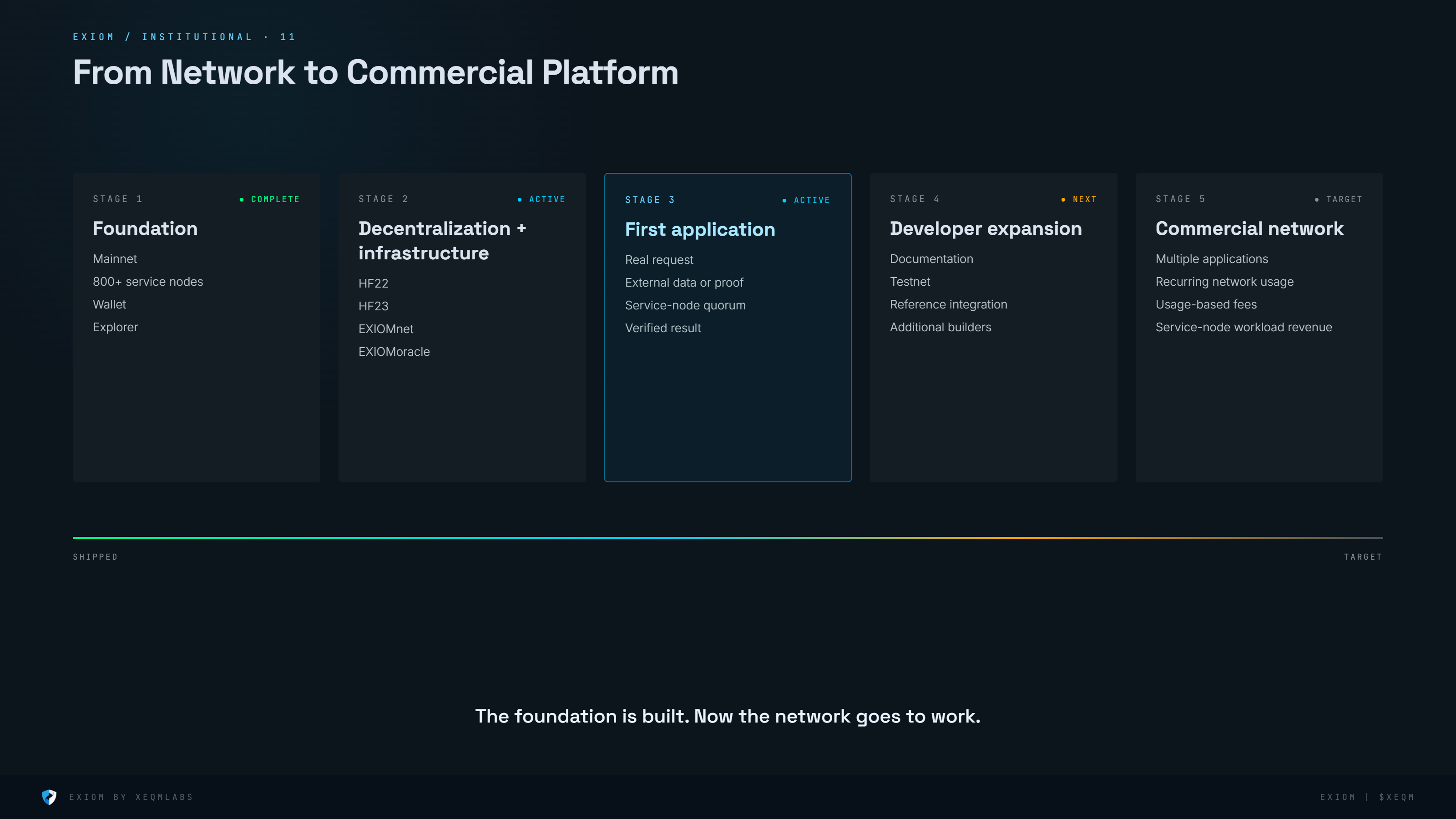
Foundation — Complete
Mainnet launch, Proof-of-Stake network, service-node infrastructure, wallet, explorer, auditable supply provenance, and more than 800 active service nodes.
Decentralization and Infrastructure — Active
HF22 is targeted for September 2026, followed by HF23. XEQMLabs is targeting completion of the current decentralization implementation by the end of 2026. EXIOMnet, developer interfaces, EXIOMoracle architecture, and service-node application workloads are being developed alongside these protocol improvements.
First Application — Active
Current work is focused on defining the exact EXIOMoracle requirements, implementing the minimum functionality locally, testing service-node quorum behavior, and completing the first end-to-end application integration.
Developer Expansion — Next
Public documentation, testnet access, reference integrations, expanded EXIOMoracle functionality, EXIOMnet access, and external developer onboarding.
Commercial Network — Target
Multiple applications consuming EXIOM infrastructure, recurring platform usage, service-node workload revenue, and a growing ecosystem of builders.
14. The Investment Thesis
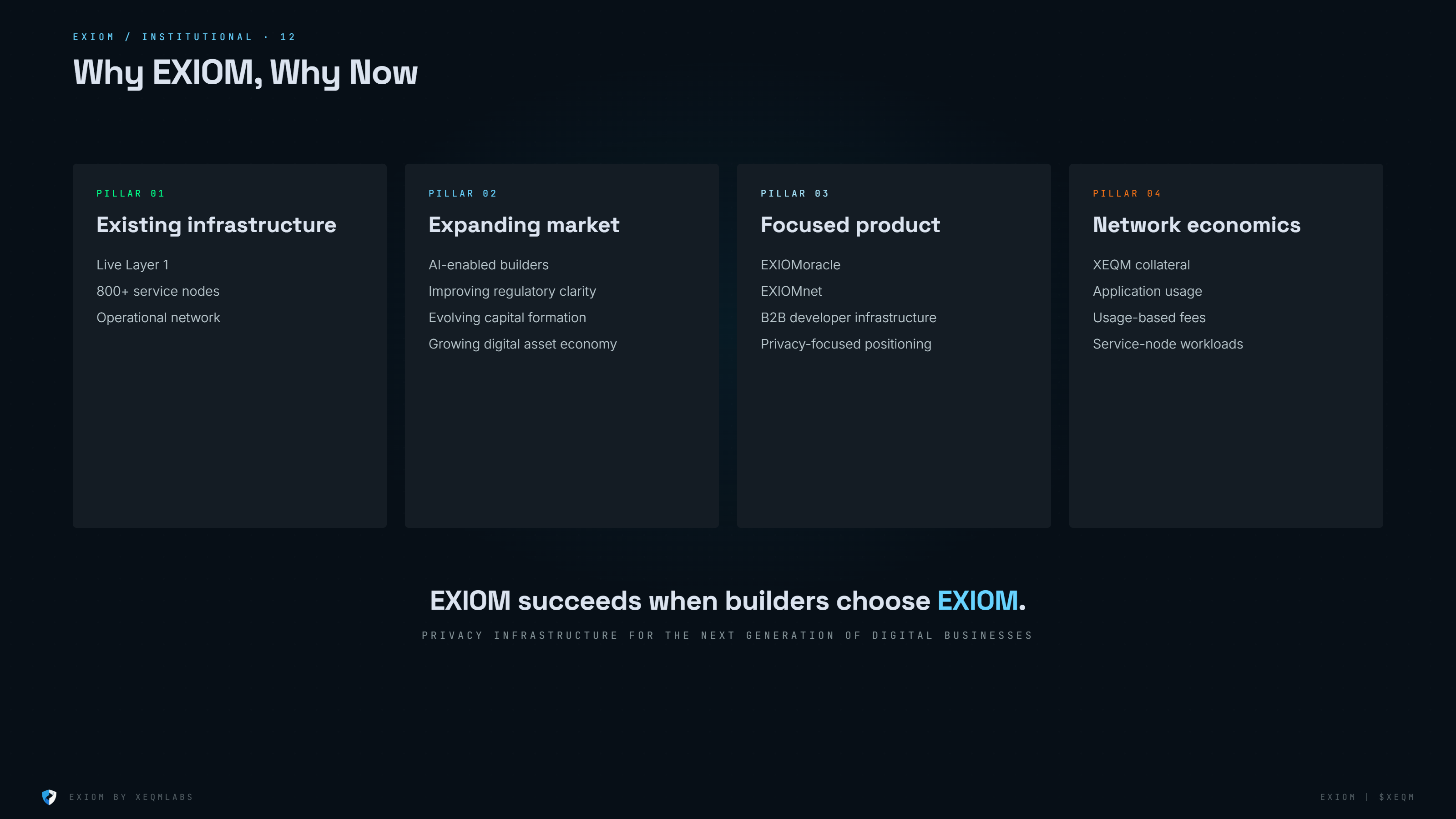
EXIOM’s investment thesis rests on the convergence of infrastructure, market timing, and execution.
The infrastructure already exists: EXIOM operates a functioning Layer 1 supported by more than 800 service nodes. The potential addressable market is expanding: AI is lowering the cost of creating software and increasing what individuals and small teams can build.
The regulatory environment is changing. The SEC has published proposed Regulation Crypto Assets, potentially creating tailored pathways for qualifying crypto ventures to raise capital, while Congress simultaneously considers comprehensive digital asset market structure legislation through the CLARITY Act. Neither development should be treated as guaranteed. Together, however, they demonstrate a substantial shift in the direction of U.S. digital asset policy. XEQMLabs believes that environment can produce more builders, more businesses, and more applications.
The product strategy is focused. Rather than competing as another general-purpose blockchain, EXIOM is being developed as privacy-focused B2B infrastructure for builders through EXIOMoracle, EXIOMnet, and the broader service-node network. The first application provides a near-term proof point: EXIOMoracle development is being driven by an actual application requirement rather than hypothetical demand.
The economic model connects adoption to network utility. Developers create applications, applications consume infrastructure, infrastructure usage generates fees, and service nodes provide the distributed resources required to deliver those services. This brings the thesis back to one fundamental metric:
Are builders choosing EXIOM?
Every application integrating EXIOMoracle, EXIOMnet, or another EXIOM service represents another potential source of network usage. EXIOM does not need to capture every application created in an expanding digital asset economy. It needs to become valuable infrastructure for a meaningful subset of them.
Execution remains the determining factor. If the next era of digital assets produces substantially more builders, those builders will require infrastructure.
XEQMLabs intends for EXIOM to be one of the networks they choose.
15. Current Status
| Component | Status |
|---|---|
| EXIOM Mainnet | Live since May 6, 2026 |
| Service Node Network | Live, 800+ nodes |
| GUI Wallet | Live |
| Node Explorer | Live |
| EXIOMoracle | Active MVP implementation |
| First Application Integration | Active development, not publicly disclosed |
| EXIOMnet | Engineering assessment and integration |
| Developer Platform | Active development |
| HF22 | Targeted for September 2026 |
| HF23 | Planned following HF22 |
| Current Decentralization Roadmap | Targeted for completion by year-end 2026 |
| EXIOM RFQ Platform | In development |
Appendix A: Core Network Parameters
| Parameter | Value |
|---|---|
| Consensus | Proof-of-Stake |
| Block Time | Approximately 60 seconds |
| Block Reward | 8.25 XEQM |
| Daily Service-Node Emission | 11,880 XEQM |
| Governance Emission | Approximately 17,857 XEQM/day |
| Full Service-Node Collateral | 200,000 XEQM |
| Minimum Operator Collateral | 100,000 XEQM |
| Maximum Operator Fee | 10% |
| Maximum Contributor Slots | 11 including operator |
| Minimum Community Contribution | 10,000 XEQM |
| Voluntary Unbonding | 14 days |
| Starting Mainnet Supply | 276,917,604 XEQM |
| Active Service Nodes | 800+ as of August 2026 |
| Quorum Size | 12 |
Appendix B: Regulatory Context
Regulation Crypto Assets. On August 21, 2026, the SEC published proposed Regulation Crypto Assets. The proposed rules would create a tailored offering regime for certain investment contracts involving crypto assets. The proposal includes:
- A startup exemption allowing qualifying offerings of up to $5 million during a four-year period
- A fundraising exemption allowing qualifying offerings of up to $75 million during each 12-month period
- Principles-based disclosure requirements
- Additional financial statement and ongoing reporting requirements for the larger fundraising exemption
- Continued application of federal antifraud and antimanipulation provisions
- A conditional safe harbor concerning when a qualifying crypto asset would no longer be subject to an investment contract for purposes of the federal definition of a security
The proposal remains subject to the SEC rulemaking process and may change before adoption.
CLARITY Act. The Digital Asset Market Clarity Act seeks to establish a comprehensive federal framework governing digital asset market structure and regulatory jurisdiction. The legislation has advanced substantially through Congress but remains subject to further consideration, negotiation, amendment, and voting.
XEQMLabs views both Regulation Crypto Assets and comprehensive market structure legislation as potential catalysts for expansion of the U.S. digital asset builder economy. Neither should be interpreted as regulatory approval of EXIOM, XEQM, or any future product, offering, or application.
Disclaimer
This document describes the current architecture, strategy, development direction, economic model, and intended roadmap of EXIOM. EXIOM remains under active development. Features, timelines, economic structures, and technical implementations described as planned or under development may change following engineering, security, legal, economic, or operational review. Regulatory proposals and pending legislation discussed in this document may be amended, delayed, rejected, or otherwise changed.
This document is provided for informational purposes and does not constitute an offer to sell or solicitation to purchase XEQM or any other security, nor does it constitute financial, investment, legal, or tax advice. Nothing in this document represents a promise of price appreciation, investment return, exchange listing, regulatory classification, or future market value.